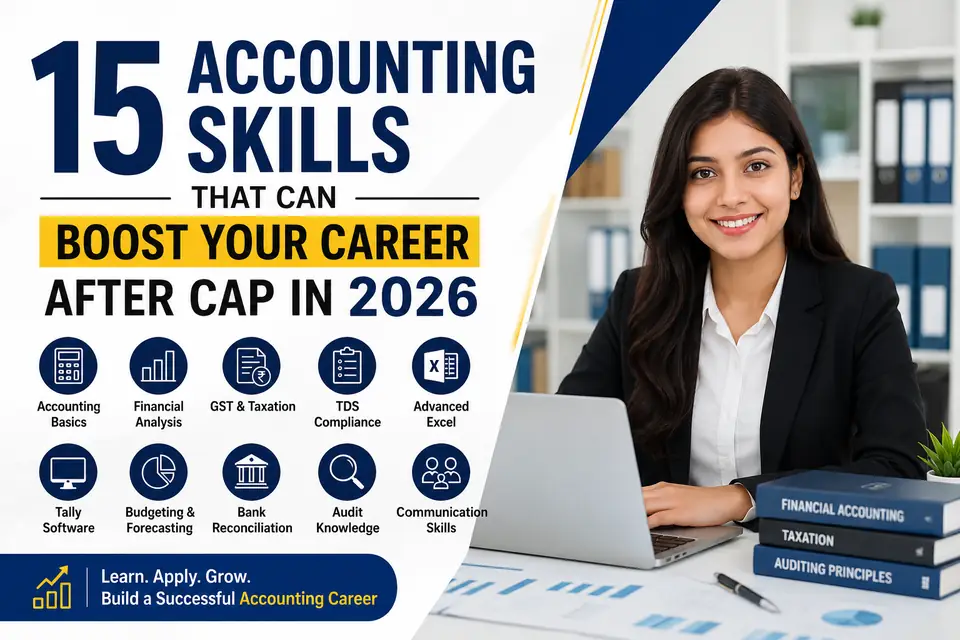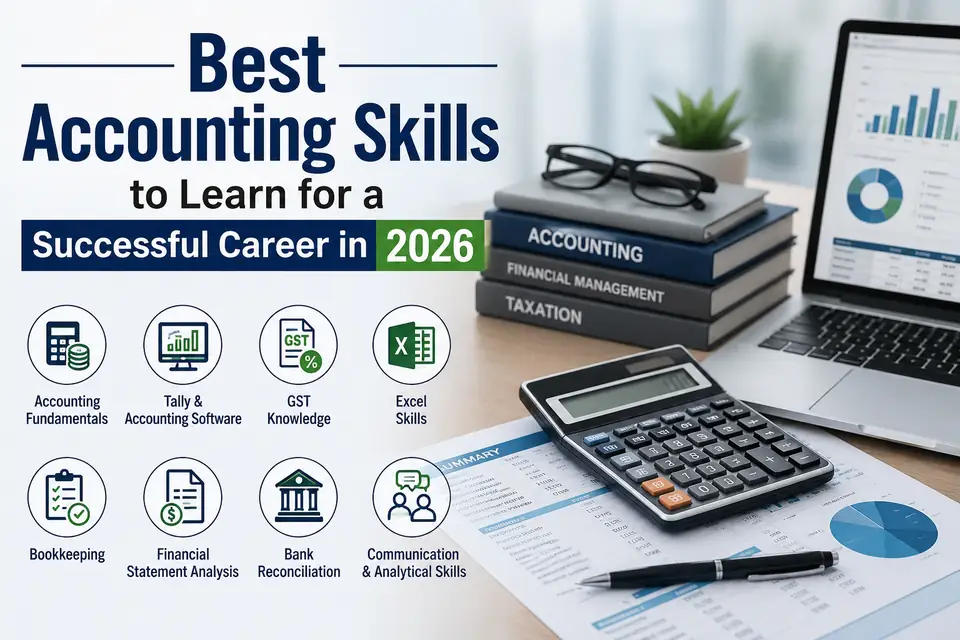
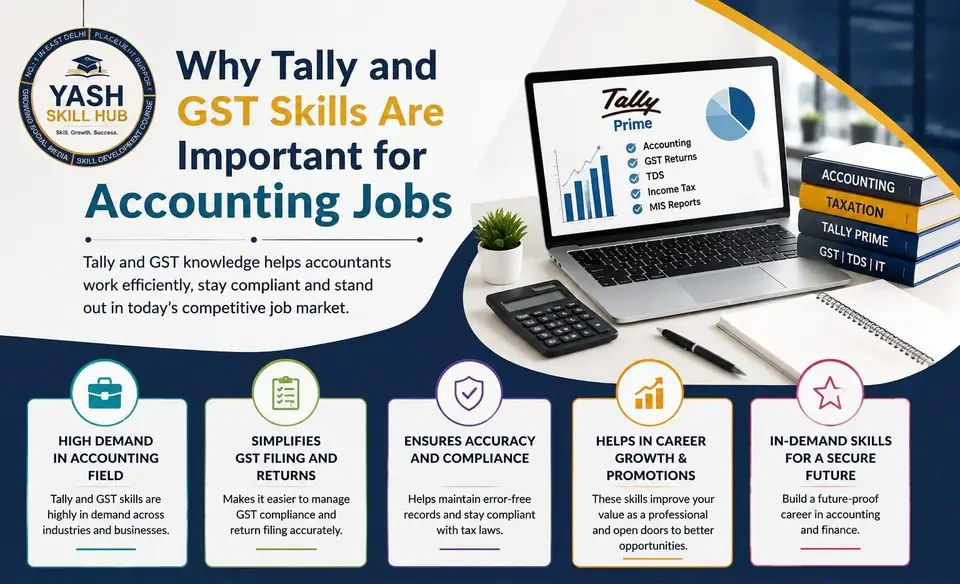
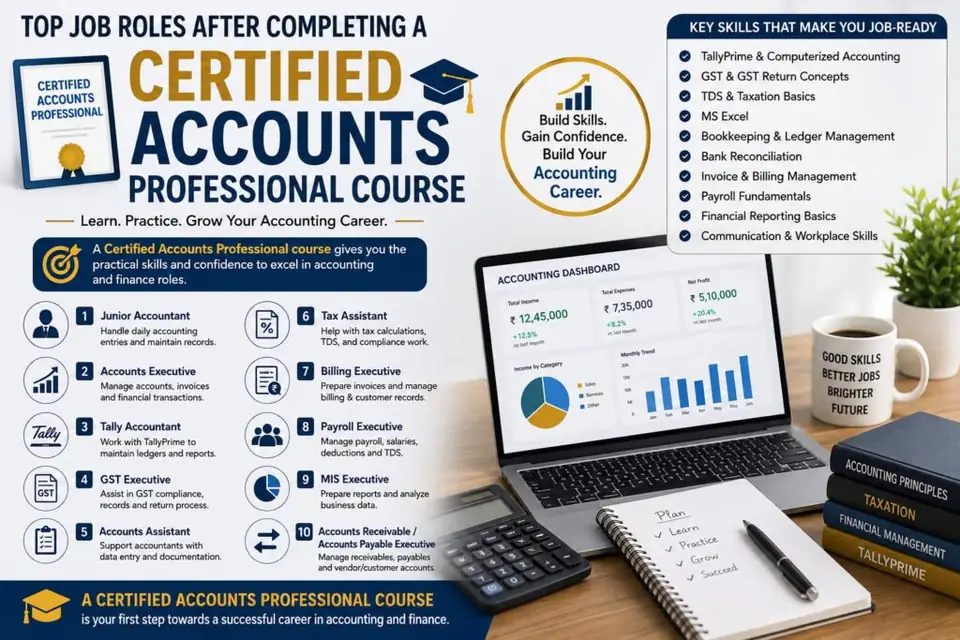
A Certified Accounts Professional course can help students and freshers develop practical accounting skills needed for entry-level jobs in accounting and finance. Along with accounting concepts, learning tools such as Tally, GST, TDS, Excel, and computerized accounting can make candidates more prepared for real-world workplace requirements.
1. Junior Accountant
A Junior Accountant is one of the most common career options for beginners. The role may include recording financial transactions, maintaining ledgers, preparing invoices, handling basic bookkeeping, and assisting senior accountants with daily accounting activities.
2. Accounts Executive
Accounts Executives handle day-to-day accounting work for businesses. Their responsibilities can include maintaining accounts, preparing financial records, managing invoices, checking transactions, and assisting with monthly accounting activities. Practical knowledge of accounting software can be useful for this role.
3. Tally Accountant
Tally Accountants work with accounting software such as TallyPrime to maintain company accounts and financial records. They may manage ledgers, vouchers, bank reconciliation, inventory records, and other accounting tasks. Tally skills can be particularly useful for candidates looking for practical accounting jobs.
4. GST Executive
GST Executives assist businesses with GST-related accounting and compliance activities. Their work may include maintaining GST records, preparing information for GST returns, checking invoices, and supporting GST-related documentation. Knowledge of GST can help freshers become more job-ready.
5. Accounts Assistant
An Accounts Assistant supports the accounting department with routine financial and administrative tasks. This can include data entry, invoice management, maintaining records, bank-related entries, documentation, and assisting accountants with financial reports.
6. Tax Assistant
A Tax Assistant may help with basic taxation-related work, documentation, calculations, records, and compliance activities under the supervision of experienced professionals. Knowledge of TDS, GST, income tax basics, and accounting can be beneficial for this career path.
7. Billing Executive
Billing Executives are responsible for preparing invoices, checking billing information, maintaining customer records, and coordinating with other departments regarding payments and transactions. Basic accounting and computer skills can help candidates perform these responsibilities efficiently.
Learn this practically at Yash Skill Hub
Free counselling and a demo class at our Vishwas Nagar centre. Tally, GST, TDS and Excel on real company data.
8. Payroll Executive
Payroll Executives assist with salary-related processes, employee records, attendance information, deductions, and payroll documentation. Understanding basic accounting, taxation, TDS, and Excel can be valuable for candidates interested in payroll-related roles.
9. MIS Executive
An MIS Executive works with business data and prepares reports for management. Strong Excel skills, data management knowledge, and an understanding of accounting information can help candidates pursue this type of position.
10. Accounts Receivable or Accounts Payable Executive
Accounts Receivable professionals generally handle money that a business needs to collect from customers, while Accounts Payable professionals work with payments and amounts owed to suppliers. These roles require good record-keeping, accuracy, and knowledge of accounting processes.
11. Financial Accounting Executive
A Financial Accounting Executive is responsible for maintaining financial records, recording business transactions, preparing basic financial reports, and assisting with month-end accounting activities. A Certified Accounts Professional Course can help candidates develop practical knowledge of bookkeeping, ledger management, bank reconciliation, and financial reporting required for this role.
12. Finance Executive
A Finance Executive assists with financial planning, expense tracking, payment management, financial documentation, and maintaining accurate business records. Candidates with practical knowledge of accounting, TallyPrime, GST, TDS, and Excel gained through a Certified Accounts Professional Course can build a strong foundation for this career path.
13. Bookkeeping Executive
A Bookkeeping Executive is responsible for maintaining accurate financial records of a business. Their work may include recording daily transactions, maintaining journals and ledgers, tracking income and expenses, preparing invoices, and organizing financial documents. They may also assist with bank reconciliation and checking accounting entries.
Strong knowledge of basic accounting principles, TallyPrime, Excel, and bookkeeping practices can help candidates perform this role effectively. A Certified Accounts Professional Course can provide practical training that helps freshers understand how bookkeeping activities are performed in real business situations.
14. Audit Assistant
An Audit Assistant supports auditors and accounting professionals during the process of reviewing financial records and business transactions. Their responsibilities may include checking invoices, verifying accounting entries, organizing financial documents, comparing records, and assisting with audit-related reports.
Attention to detail and accuracy are important skills for this position because audit work requires careful examination of financial information. Knowledge of accounting, taxation, Excel, and computerized accounting can help candidates prepare for this career path. A Certified Accounts Professional Course can help students develop the accounting foundation required for entry-level audit support roles.
15. Financial Data Entry Executive
A Financial Data Entry Executive works with accounting and financial information and ensures that transactions are entered accurately into accounting systems or databases. Their responsibilities may include entering purchase and sales transactions, updating customer and supplier records, recording expenses, maintaining invoices, and checking financial data.
Accuracy, typing skills, computer knowledge, Excel, and familiarity with accounting software are useful for this position. Candidates who complete a Certified Accounts Professional Course can develop practical knowledge of accounting transactions and software, helping them become better prepared for financial data-related roles.
Skills That Can Help You Get an Accounting Job
Completing a CAP course is only one part of building an accounting career. Students should also focus on developing practical skills such as:
- TallyPrime and computerized accounting
- GST and GST return concepts
- TDS and taxation basics
- MS Excel
- Bookkeeping and ledger management
- Bank reconciliation
- Invoice and billing management
- Payroll fundamentals
- Financial reporting basics
- Communication and workplace skills
Why Choose a Certified Accounts Professional Course?
A practical Certified Accounts Professional course can help freshers understand how accounting concepts are applied in real business situations. Instead of focusing only on theoretical knowledge, students can develop practical skills that may be useful for accounting, taxation, billing, payroll, and finance-related roles.
For students who want to begin an accounting career, learning software and taxation along with accounting fundamentals can provide a stronger foundation. With continuous practice and skill development, freshers can prepare themselves for entry-level opportunities and gradually work toward higher responsibilities.
Career Growth After an Entry-Level Accounting Job
An entry-level accounting position can be the beginning of a long-term career path. After gaining practical experience, professionals may take on additional responsibilities and move toward senior positions.
A Junior Accountant can gradually progress toward Accountant, Senior Accountant, Accounts Manager, or other finance-related positions depending on experience and qualifications.
Similarly, professionals working in GST, taxation, payroll, MIS, accounts receivable, or accounts payable can develop specialized expertise and move into higher-level roles.
Continuous learning is important because accounting software, taxation requirements, business practices, and reporting systems can change over time.
Who Should Choose a Certified Accounts Professional Course?
A Certified Accounts Professional Course can be suitable for students, freshers, graduates, and candidates who want to develop practical accounting skills. Students who want to build a career in bookkeeping, taxation, Tally, GST, payroll, billing, or finance can use this type of course to develop a strong foundation.
Candidates from different educational backgrounds can also explore accounting careers by learning practical accounting concepts and software. A Certified Accounts Professional Course can help learners understand how accounting activities are performed in real business environments.
What Skills Can You Learn in a Certified Accounts Professional Course?
A well-structured Certified Accounts Professional Course can help students develop a combination of accounting knowledge and practical skills. Depending on the course curriculum, students may learn:
- Basic and advanced accounting concepts
- TallyPrime and computerized accounting
- GST and GST-related accounting
- TDS and taxation fundamentals
- MS Excel for accounting
- Bookkeeping
- Bank reconciliation
- Purchase and sales accounting
- Invoice and billing management
- Payroll fundamentals
- Financial reporting
- Accounts payable and receivable
- Practical business accounting
These skills can help students prepare for different entry-level positions after completing a Certified Accounts Professional Course.
Benefits of Completing a Certified Accounts Professional Course
One of the major benefits of a Certified Accounts Professional Course is that it can help students focus on practical skills instead of only theoretical concepts.
Some potential benefits include:
- Practical accounting knowledge – Students can learn how accounting concepts are applied in businesses.
- Accounting software skills – Practical TallyPrime knowledge can help candidates prepare for software-based accounting work.
- GST and taxation knowledge – Understanding GST and TDS can be useful for accounting and taxation-related positions.
- Better job preparation – Practical training can help freshers feel more confident when applying for entry-level roles.
- Multiple career options – Candidates can explore accounting, billing, payroll, taxation, bookkeeping, MIS, and finance-related positions.
- Improved workplace confidence – Regular practice can help students become more comfortable handling accounting tasks.
How a Certified Accounts Professional Course Helps Freshers
Freshers often face difficulty when searching for their first accounting job because employers may expect candidates to understand practical accounting processes. A Certified Accounts Professional Course can help bridge the gap between classroom knowledge and workplace requirements.
For example, a fresher may understand the theory of journal entries but may not know how to record transactions using accounting software. Practical training allows students to practice such tasks and understand how accounting information is maintained in an organization.
Career Growth After Completing a Certified Accounts Professional Course
Completing a Certified Accounts Professional Course can be the beginning of an accounting career rather than the final step. After gaining experience, professionals can develop specialized skills and take on greater responsibilities.
A fresher may begin as an Accounts Assistant or Junior Accountant and later progress toward positions such as Accountant, Senior Accountant, Accounts Executive, Finance Executive, or Accounts Manager, depending on experience, qualifications, and professional development.
Continuous learning is important because accounting software, taxation procedures, reporting requirements, and business practices can change over time.
How to Choose the Right Certified Accounts Professional Course
Before enrolling in a Certified Accounts Professional Course, students should check whether the course provides practical training rather than focusing only on theory.
Look for a course that covers relevant areas such as:
- TallyPrime
- GST
- TDS
- MS Excel
- Practical bookkeeping
- Payroll
- Taxation
- Financial reporting
- Business accounting
- Practical assignments or projects
Students should also check the course duration, syllabus, certification, practical exposure, learning support, and career guidance before making a decision.
Frequently Asked Questions
1. What is a Certified Accounts Professional Course?
A Certified Accounts Professional Course is a professional accounting training program designed to help learners develop accounting and practical finance-related skills. The curriculum may include accounting concepts, computerized accounting, TallyPrime, GST, TDS, Excel, bookkeeping, payroll, and taxation.
2. Is a Certified Accounts Professional Course suitable for freshers?
Yes. A Certified Accounts Professional Course can be useful for freshers who want to develop practical accounting skills before applying for entry-level positions.
3. What jobs can I get after a Certified Accounts Professional Course?
Depending on your skills and experience, you can explore roles such as Junior Accountant, Accounts Executive, Tally Accountant, GST Executive, Accounts Assistant, Tax Assistant, Billing Executive, Payroll Executive, MIS Executive, Bookkeeping Executive, Audit Assistant, and Finance Executive.
4. Is Tally important for accounting jobs?
TallyPrime and other computerized accounting tools are useful skills for many accounting positions. Learning Tally along with accounting fundamentals can help candidates understand how businesses maintain computerized financial records.
5. Can I start an accounting career without experience?
Freshers can apply for entry-level accounting positions and build experience gradually. Completing a Certified Accounts Professional Course and developing practical skills can help candidates prepare for their first accounting opportunity.
Tips for Freshers Starting an Accounting Career
If you are a fresher, consider the following tips:
- Practice accounting regularly rather than relying only on theoretical knowledge.
- Learn TallyPrime and become comfortable with common accounting transactions.
- Improve Excel skills because spreadsheets are widely used in accounting departments.
- Understand GST and TDS basics to become more familiar with taxation-related accounting work.
- Work on accuracy because accounting requires careful handling of financial information.
- Create practical projects to demonstrate your skills to potential employers.
- Prepare for accounting interviews by revising basic concepts and practical questions.
- Improve communication skills so you can work effectively with colleagues and clients.
- Keep learning even after getting your first job.
- Gain practical experience through internships, training, projects, or entry-level positions whenever possible.
Conclusion
There are several career opportunities available after completing a Certified Accounts Professional course, including Junior Accountant, Accounts Executive, Tally Accountant, GST Executive, Accounts Assistant, Tax Assistant, Billing Executive, Payroll Executive, and MIS Executive. The right career path depends on your skills, interests, and practical experience.
If you are planning to start a career in accounting, developing practical knowledge of Tally, GST, TDS, Excel, bookkeeping, and taxation can help you become more confident and job-ready. A Certified Accounts Professional Course course can be a useful starting point for building these skills and taking your first step toward a career in accounting and finance.
For freshers, the most important step is to build a strong combination of accounting knowledge and practical skills. Learning TallyPrime, GST, TDS, Excel, bookkeeping, payroll, taxation, and financial reporting can help candidates become better prepared for entry-level accounting positions.
A Certified Accounts Professional Course can be a useful starting point for students and freshers who want to develop these practical skills and explore career opportunities in accounting and finance. With continuous learning, practical experience, and professional development, candidates can gradually build a successful and rewarding accounting career.
If your goal is to start working in accounting, focus not only on earning a certificate but also on developing skills that you can confidently dem